Truly Extraordinary': The Brightest Space Laser Ever Seen Is Shooting at Us from Halfway Across the Universe
Astronomy & Space Science
'Truly Extraordinary': The Brightest Space Laser Ever Seen Is Shooting at Us from Halfway Across the Universe
Astronomers have detected the brightest and most distant natural space laser ever recorded — a colossal beam of microwaves blazing toward Earth from a galaxy collision 8 billion light-years away. The discovery was only possible thanks to a strange space-time trick first predicted by Einstein more than a century ago.
But to understand why this discovery matters, it helps to start at the beginning — with the invention of the maser itself.

📡 A Brief History of Masers (and Lasers)
The story of masers begins in the early 1950s, at the intersection of physics, radar technology, and Cold War science funding. After World War II, many physicists who had worked on radar and microwave technology were looking for peacetime applications for what they had learned.
The First Maser — 1953
In 1953, American physicist Charles Townes and his team at Columbia University built the world's first maser — a device that amplified microwave radiation by exciting ammonia gas molecules and stimulating them to emit coherent microwave energy. The word MASER stands for Microwave Amplification by Stimulated Emission of Radiation.
The principle behind it was deceptively simple: pump energy into a gas of molecules, excite them to a higher energy state, and when one molecule releases its energy as a microwave photon, that photon triggers neighbouring molecules to do the same — creating a cascade of identical, synchronized microwaves. This is what "stimulated emission" means.
The Soviet Contribution — 1954
Independently and almost simultaneously, Soviet physicists Nikolay Basov and Alexander Prokhorov developed the same concept in the USSR. The parallel discovery sparked a major scientific debate over priority — one that was eventually settled diplomatically when all three scientists (Townes, Basov, and Prokhorov) shared the Nobel Prize in Physics in 1964.
From Microwave to Light — The Laser, 1960
Townes and his brother-in-law Arthur Schawlow then extended the same concept from microwaves to visible light, publishing a landmark theoretical paper in 1958. Two years later, in 1960, Theodore Maiman built the first working laser using a ruby crystal and a flash lamp. The LASER — Light Amplification by Stimulated Emission of Radiation — was born.
- 1917Einstein theorizes "stimulated emission" in a paper on quantum mechanics — the fundamental principle behind all lasers and masers.
- 1953Charles Townes builds the first maser at Columbia University using excited ammonia molecules.
- 1954Basov and Prokhorov independently develop the maser concept in the Soviet Union.
- 1958Townes and Schawlow publish the theoretical framework for an optical laser.
- 1960Theodore Maiman builds the first working laser using a synthetic ruby crystal.
- 1964Townes, Basov, and Prokhorov share the Nobel Prize in Physics.
- 1965Astronomers detect the first natural "cosmic maser" — hydroxyl (OH) molecules in space emitting amplified microwave radiation.
- 1982The first "megamaser" is discovered — a natural cosmic maser millions of times more powerful than anything in our own galaxy.
- 2025The brightest and most distant megamaser ever found is detected by the MeerKAT telescope — 8 billion light-years away.
Maser vs. Laser — What's the Difference?
- Maser: Amplifies microwave radiation. The "M" stands for Microwave.
- Laser: Amplifies visible light (or infrared/ultraviolet). The "L" stands for Light.
- Both work on the same quantum principle: stimulated emission of radiation, first described by Einstein in 1917.
- Masers are now used in atomic clocks, deep-space communication systems, and astronomical research.
🌌 What Is a Megamaser?
In 1965, astronomers made a startling discovery: outer space contains natural masers. Clouds of molecules — particularly hydroxyl (OH), water (H₂O), and methanol — in interstellar space can naturally emit highly amplified microwave radiation when energised by nearby stars or violent galactic events.
These cosmic masers were interesting, but in 1982 something far more spectacular was found: a maser so powerful it dwarfed everything seen before. It was dubbed a megamaser — a natural space laser millions of times more luminous than the brightest masers in our own Milky Way galaxy.
Megamasers are almost always found in the same dramatic setting: two galaxies colliding. When galaxies merge, vast clouds of gas are compressed and heated. This energises huge reservoirs of hydroxyl (OH) molecules, which then emit powerful, amplified bursts of microwave radiation — a megamaser.

Because megamasers are so energetic, they are visible across enormous cosmic distances — making them invaluable tools for studying how ancient galaxies formed and evolved in the early universe. Astronomers call them "cosmic beacons."
🔭 The New Discovery: A "Gigamaser" from 8 Billion Light-Years Away
In February 2025, a team led by astronomer Thato Manamela of the University of Pretoria, South Africa, announced the detection of a remarkable new megamaser — the most distant and brightest ever found.
Using the MeerKAT telescope — an array of 64 linked radio dishes in the Karoo desert of South Africa — the team detected a beam of microwaves coming from a galaxy system called HATLAS J142935.3–002836, approximately 8 billion light-years from Earth.
The microwaves detected are around 18 centimetres in wavelength — the characteristic emission of excited hydroxyl molecules. What's astounding is just how bright this signal is: it is so far beyond the scale of any previously known megamaser that the researchers have proposed it be classified as a "gigamaser" — the next order of magnitude up.
"This system is truly extraordinary. We are seeing the radio equivalent of a laser halfway across the universe."— Thato Manamela, Lead Author, University of Pretoria
The light (or microwaves) we detect from HATLAS J142935.3–002836 were emitted when the universe was only about half its current age — offering a rare window into the violent, formative era of galaxy evolution.
🪐 What Is Gravitational Lensing? (And Why It Made This Discovery Possible)
Here's the remarkable thing: a megamaser 8 billion light-years away should be far too faint to detect, even with a powerful telescope like MeerKAT. So how was it spotted? The answer lies in one of Einstein's most mind-bending predictions — gravitational lensing.


The Basic Idea
Einstein's General Theory of Relativity (1915) made a stunning prediction: massive objects warp the fabric of space-time around them. This means that when light (or microwaves) travel through space, they don't always travel in a perfectly straight line — they follow the curves in space-time caused by gravity.
If a sufficiently massive object — like a galaxy or a galaxy cluster — sits exactly between us and a distant light source, its gravity bends the radiation from that distant source around it. From our point of view on Earth, this creates a striking visual effect: the distant source appears magnified, distorted, or even multiplied into a ring of light around the middle object.
🔬 Gravitational Lensing — Step by Step
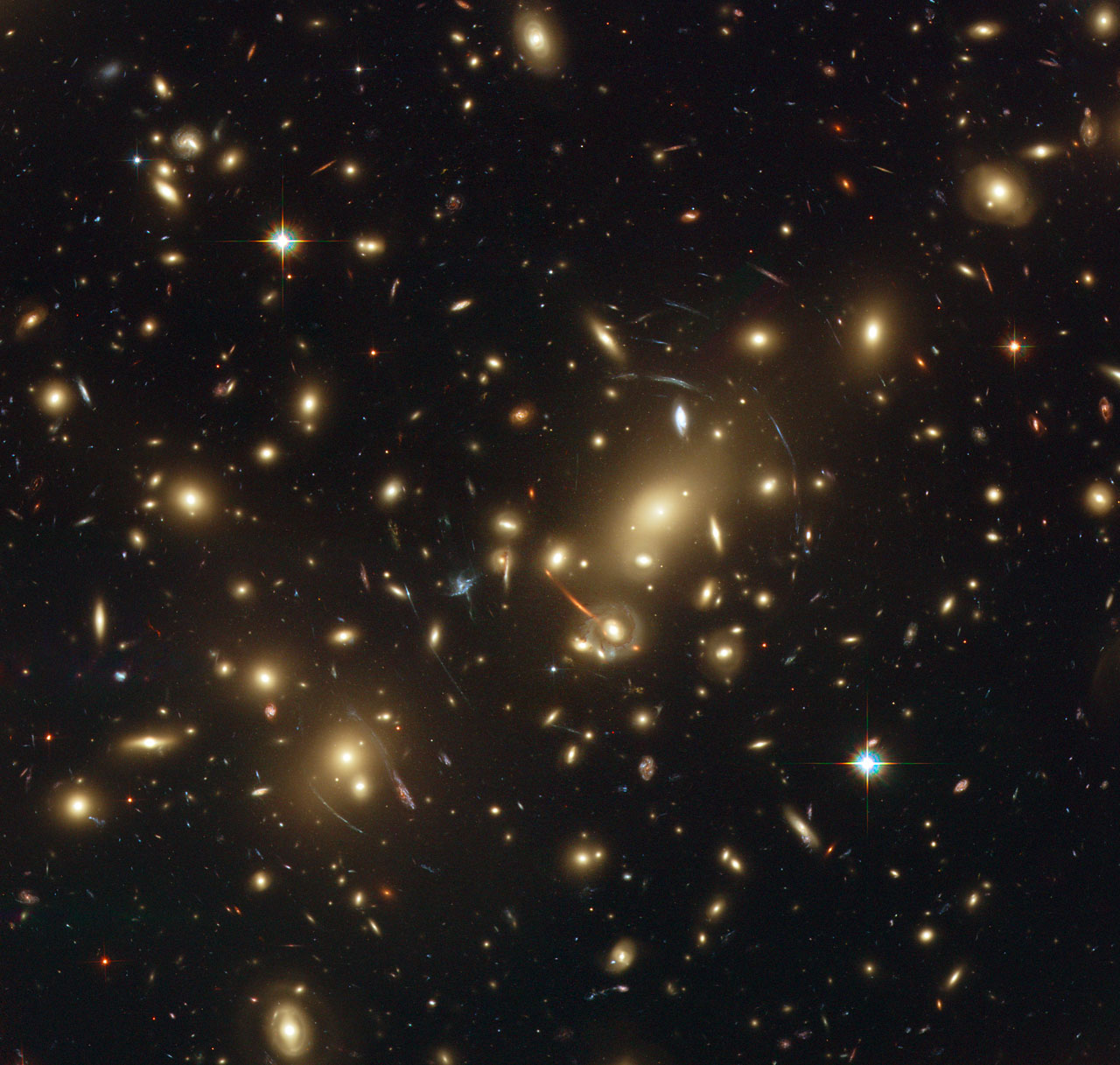
Why Does This Matter for the Discovery?
The HATLAS J142935.3–002836 system was actually first identified back in 2014, when images from the Hubble Space Telescope and the ALMA radio observatory revealed a partial Einstein ring around it — a strong sign that gravitational lensing was at work. At the time, no one knew a megamaser was hidden within the lensed system.
When the MeerKAT team pointed their dishes at gravitationally lensed systems like this one, they were essentially using the universe itself as a telescope — letting the natural magnification of gravitational lensing reveal signals that would otherwise be invisible.

🚀 What Comes Next?
The team plans to systematically point MeerKAT at other known gravitationally lensed galaxy systems, hunting for more hidden megamasers — and potentially more gigamasers — that would otherwise be invisible to us. The approach essentially gives astronomers a shortlist of targets where the universe's own optics have already done the amplification.
"This is just the beginning. We don't want to find just one system — we want to find hundreds to thousands."— Thato Manamela, University of Pretoria
A larger sample of megamasers from the early universe would allow scientists to study, in unprecedented detail, how ancient galaxies collided and merged — a process that shaped the universe we live in today.
And all of it, ultimately, rests on a chain of ideas stretching from Einstein's 1917 paper on stimulated emission, to Townes' laboratory in 1953, to a radio dish in the South African desert pointing at a smudge of light 8 billion light-years away — and finding a beacon from the dawn of galaxies.
Sources: Manamela et al., Monthly Notices of the Royal Astronomical Society: Letters (2025, accepted) · Live Science · NASA/ESA Hubble · SARAO/MeerKAT · ALMA Observatory
Comments
Post a Comment